If Brand Search Isn't Incremental, Why Keep Paying for It?
Competitive defense, funnel control and auction intelligence can all justify brand spend. The trick is pricing each one on purpose.
Key takeaways
Low incrementality doesn’t mean you should shut brand search off. It means you should stop paying as if every brand conversion came from a new customer. Decide what the spend is buying and pay what that’s worth.
Price your defense, don’t max it out. Use Target Impression Share with a max CPC cap, and lower the cap until you start losing coverage you care about. In one account, this cut the core brand click from $14.73 to $4–5.
The page after the click can make brand ads pay off. Paid lets you choose the message and the landing page. When that page is weak, buying more of the top spot just buys pricier clicks: top-spot share went from 13% to 31%, while conversions per 100 clicks fell from 2.5 to 1.4.
Staying in the auction lets you see who’s bidding. Auction Insights only reports on auctions you’re in, so a low-cost brand campaign keeps showing you who’s bidding on your name. That only works if the bid is high enough to win real impressions.
Run a brand search incrementality test, and you'll often get an uncomfortable answer: spend less on brand ads and total brand traffic barely changes. Paid clicks fall, organic clicks rise, and it looks like you've been buying traffic you'd have gotten for free. As a paid search marketing agency, we see this pattern consistently.
It is tempting to write off the spend as waste and pause the campaigns entirely. Completely cutting brand search is usually a mistake, but leaving it on autopilot is just as risky
When paid brand search adds little incremental traffic, stop treating every attributed conversion like a net-new buyer. Figure out the specific strategic value the campaign provides and set your budget around that
In our experience, there are three good reasons to keep some brand spend:
Defending your name against competitors
Steering searchers into a better conversion path
Keeping visibility into who's bidding in your auction
1. Competitive defense: don't give up the top spot by default
People who search your name usually want you. But the results page isn't reserved for you. Competitors can bid on your name and show up above your top organic listing.
While not every competitor ad takes business from you, the lost revenue is real and easy to track
"For your exact brand name and close navigational queries, track Search absolute top impression share. This metric measures the percentage of available auctions where your ad took the very first spot. That is distinct from regular impression share, which shows how often you appeared at all, and absolute top impression rate, which only measures where your existing ads landed."
Pair it with Auction Insights, which shows how often competitors appear alongside you and how often they outrank you. Then pick a coverage target based on the actual risk and economics. 100% absolute top share isn't automatically worth any price.
What we've seen: A healthcare software company we took over had just 21% impression share on its own brand terms, even though only three competitors were in the auction and none held more than 10%. Brand CPCs were higher than non-brand ($14.37 vs. $12.33). The bid strategy was the problem, not the competitors.
2. Find the lowest CPC that keeps the coverage you need
Many brand campaigns run on one of these bid strategies:
Target CPA
Target ROAS
Maximize Conversions
Those strategies work when the goal is conversion volume or value. On brand, they can hide how much you're paying just to hold a position, and they often bid hard for clicks that would have converted anyway.
They can also make CPCs swing for reasons unrelated to competition. At an HR-tech SaaS client, brand ran on uncapped Maximize Conversions fed by CRM conversions that arrived days or weeks after the click. Brand CPCs ranged from $1.20 to $4.75 over the year as the algorithm reacted to delayed signals.
If a campaign's main job is visibility, test Target Impression Share with the location set to the absolute top of results and a maximum CPC limit:
Pick the absolute top share you want to defend, based on competitor pressure and what's at stake.
Start with a CPC cap high enough to reach that target.
Lower the cap in steps, keeping everything else as stable as you can.
Watch absolute top share, CPC, total brand clicks (paid + organic) and Auction Insights.
Find the point where a lower cap starts costing you meaningful coverage.
That point is the price of your defense. The right bid is the lowest sustainable cost for the coverage you've chosen to buy.
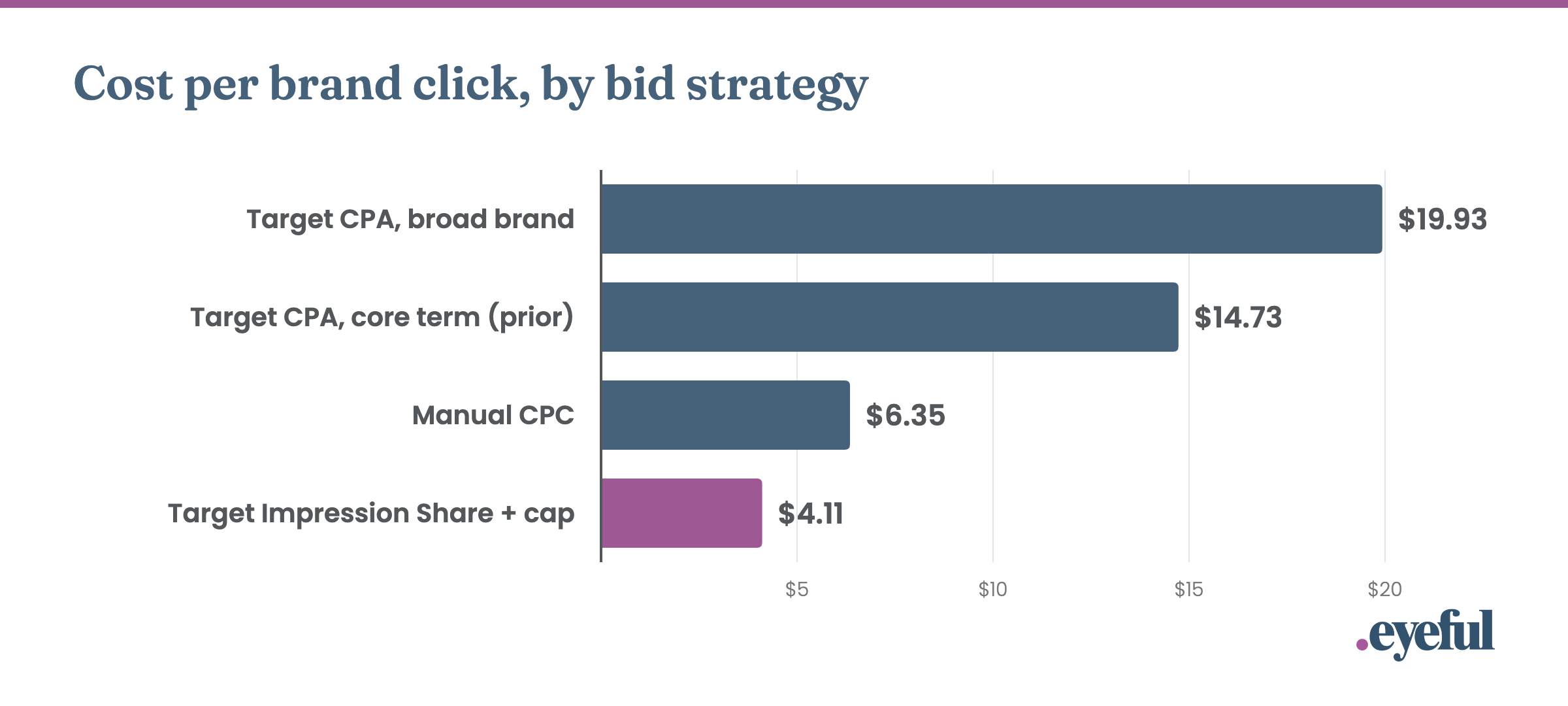
What one brand click costs, by bidding approach, in the same account. All figures are April 2026 except "core term (prior)," which is October 2025 before the restructure. The Target Impression Share campaign lost 63% of eligible impressions to ad rank at this cap. Campaigns cover overlapping but not identical brand queries, so treat this as directional. Source: Eyeful analysis, Google Ads.
Back to the healthcare software company. Moving its core brand term from Target CPA to Target Impression Share with a CPC cap cut the average click from $14.73 to $4–5. Over the same months, a Target CPA campaign on broader brand terms was paying nearly $20 a click.
The chart also shows the catch. At that cap, the campaign lost 63% of eligible impressions to ad rank. The cap was below the curve, cheaper than the coverage the client wanted to hold. The test did its job: you now know where the floor is and can step back up to it.
What we've seen: At another healthcare technology client, moving brand to Target Impression Share lowered CPCs while combined paid and organic brand clicks held steady. Organic picked up the clicks that paid gave back.
This isn't a one-time setting. New bidders show up, competitors change offers, and seasonal pushes reshape the auction. Recheck regularly, and remember that Target Impression Share pursues a placement goal. It doesn't guarantee one.
3. Paid brand can change the conversion, not just the click
Paid search lets you dictate the exact message and destination page for brand queries, while organic search results generally push traffic straight to your homepage
You can write copy around a promotion or product line, use assets to surface specific actions and send people straight to a demo, pricing, booking or checkout page. The organic result usually points to your homepage.
If that better path converts more people, shortens the journey or produces higher-value leads, and the added profit beats the click cost, the ads can pay for themselves even with no incremental visits.
The flip side: if the landing experience is weak, buying more position just buys more expensive clicks.
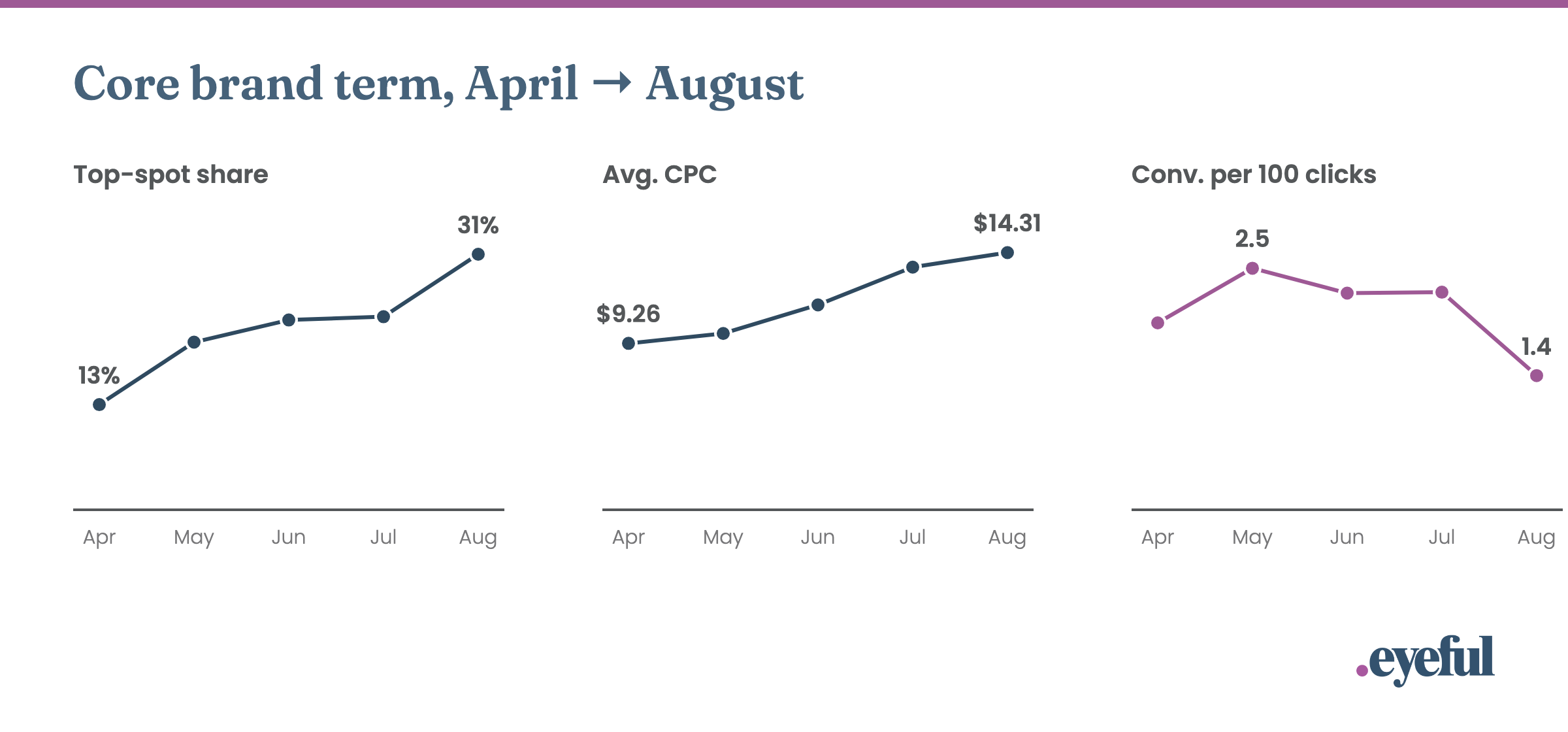
More of the top spot isn't more customers. Healthcare software company, core brand keyword, April–August 2026. Top-spot share is Search absolute top impression share. Each panel has its own scale. Google rated landing page experience "below average" on this keyword. Source: Eyeful portfolio analysis.
The same healthcare software company later leaned harder into brand bidding to grow lead volume. That was a deliberate, agreed trade-off. Absolute top share on the core brand term rose from 13% to 31%. Average CPC rose 55%. Conversions per 100 clicks fell from a 2.5 peak to 1.4. Google rated the post-click landing page experience "below average" on that keyword and most other brand terms.
That's a conversion-path problem showing up as a bidding problem. Dominating the top position failed to produce more buyers because the destination page fell flat. Improving the post-click experience would reduce acquisition costs while increasing overall conversion rates.
One caution on measurement: comparing your paid landing page's conversion rate with your organic homepage's is suggestive, not proof. The two groups differ in intent, query and device. A controlled landing page test or a geo-scoped ad test is better evidence. Ideally, measure total conversions and contribution margin across both channels.
4. The overlooked benefit: auction intelligence
There's one more reason not to disappear from brand search entirely: you learn more about the paid competitive landscape when you're in it.
Auction Insights only reports on auctions you entered. Shut off brand campaigns, and you lose visibility into who's bidding against you. A new competitor could move in aggressively, and your reports wouldn't show it.
For some businesses, a low-cost brand campaign is worth keeping as a monitoring footprint, even when they don't need to defend the top spot every day.
The goal is to participate enough to see what's happening. That can justify a very low bid, but there's a catch: a one-cent max CPC usually isn't enough. It may not win meaningful impressions, and Auction Insights needs enough data to report. A campaign that exists but never shows doesn't tell you anything.
So test down to the lowest CPC that still produces enough auction activity to show useful trends. Pair Auction Insights with organic performance, impression share data and periodic manual checks of your brand results page. And know the limits: a small footprint won't see every auction you'd enter at a defensive bid.
That gives you two operating modes: a monitoring posture that keeps you visible at minimal spend, and a defensive posture that protects a chosen level of top-spot coverage when risk rises.
5. Give every brand-search dollar a job
The simplest way to set brand spend is to separate the benefits a typical brand campaign report bundles together:
| Purpose | What to measure | How to set spend |
|---|---|---|
| Competitive defense | Absolute top impression share, competitor overlap and outranking, total business impact | The lowest cost that holds your chosen coverage |
| Conversion-path control | Incremental conversions, revenue, contribution margin | Up to the value of the proven funnel lift |
| Competitive intelligence | Auction participation and useful competitor trends | The lowest spend that produces usable monitoring data |
You might run a single campaign that balances all three, or split query groups (for example, core brand terms vs. login and support queries) to see the trade-offs clearly. Either way, one attributed ROAS number isn't enough to decide.
The takeaway: brand search is more than acquisition
If someone is already searching for you, paying for their click may not create new demand. But paying for position, message control or visibility into your auction can still make sense.
The mistake is treating every paid brand conversion as if the ad created it, and bidding accordingly.
Buy the benefit you can defend. Measure what it adds. Pay no more than it's worth.
Want a second opinion on your brand campaigns? Our senior practitioners can find the coverage your brand actually needs and the lowest price to hold it. No account managers, no junior handoffs. Let's talk.
Companion article: "Are You Paying for Branded Search Clicks You Would Have Earned Anyway?"
References: Google Ads Help on top and absolute top metrics, bidding and Target Impression Share, and Auction Insights.
Client examples are anonymized and drawn from Eyeful analyses conducted in 2025–2026.