Beyond Demand Capture: How B2B Marketers Build the Funnel That Fuels Future Pipeline
Paid search is great at catching buyers who are ready. It can't make more of them.
The B2B Demand Creation Flywheel
Key takeaways
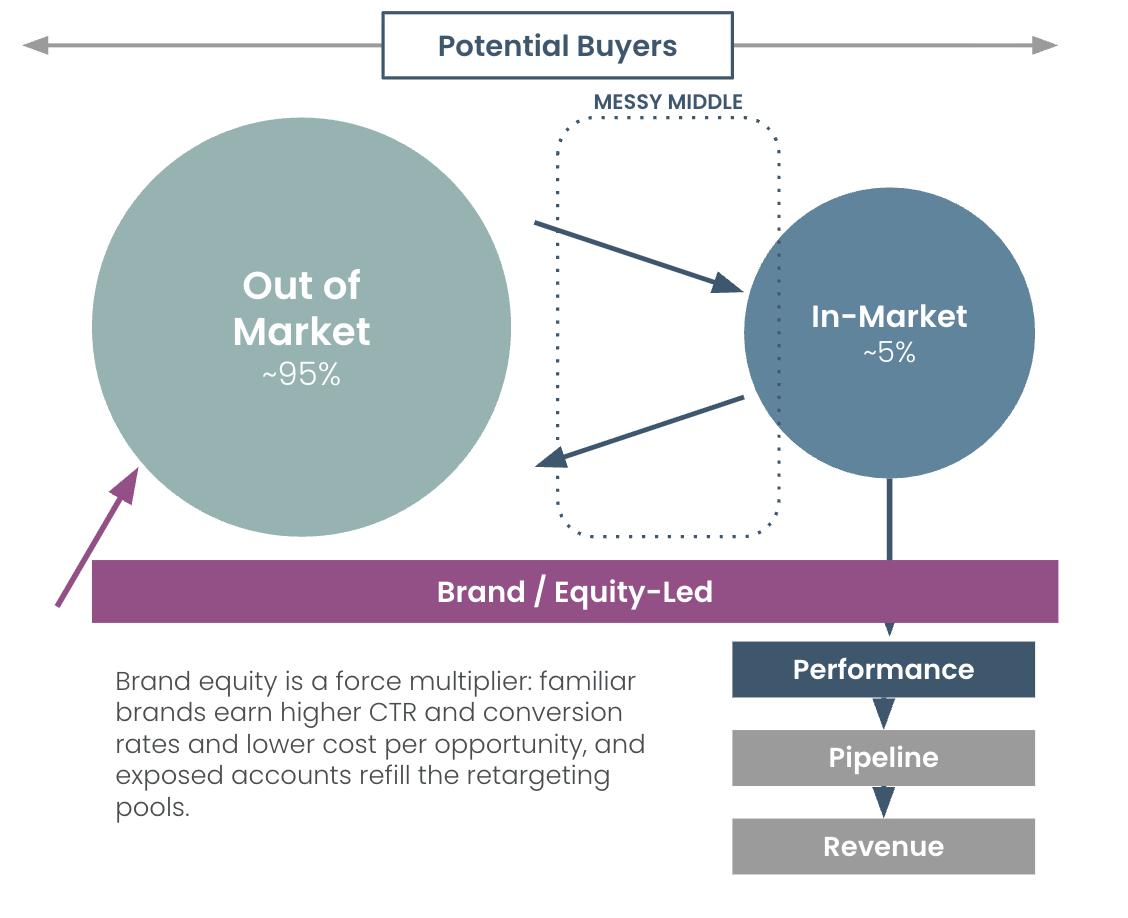
The shortlist forms before the search. About 95% of B2B buyers are out of market at any moment, and 90% end up buying from the list of brands they had in mind before research began.
You're selling to a committee, not a searcher. About 6 in 10 decision stakeholders are individual contributors, managers or directors, and the journey loops rather than runs in a line. Stay familiar to all of them.
Give each stage one job and one scorecard. Programmatic and video build familiarity out of market, social and expert content build preference in the messy middle, and search captures ready buyers efficiently.
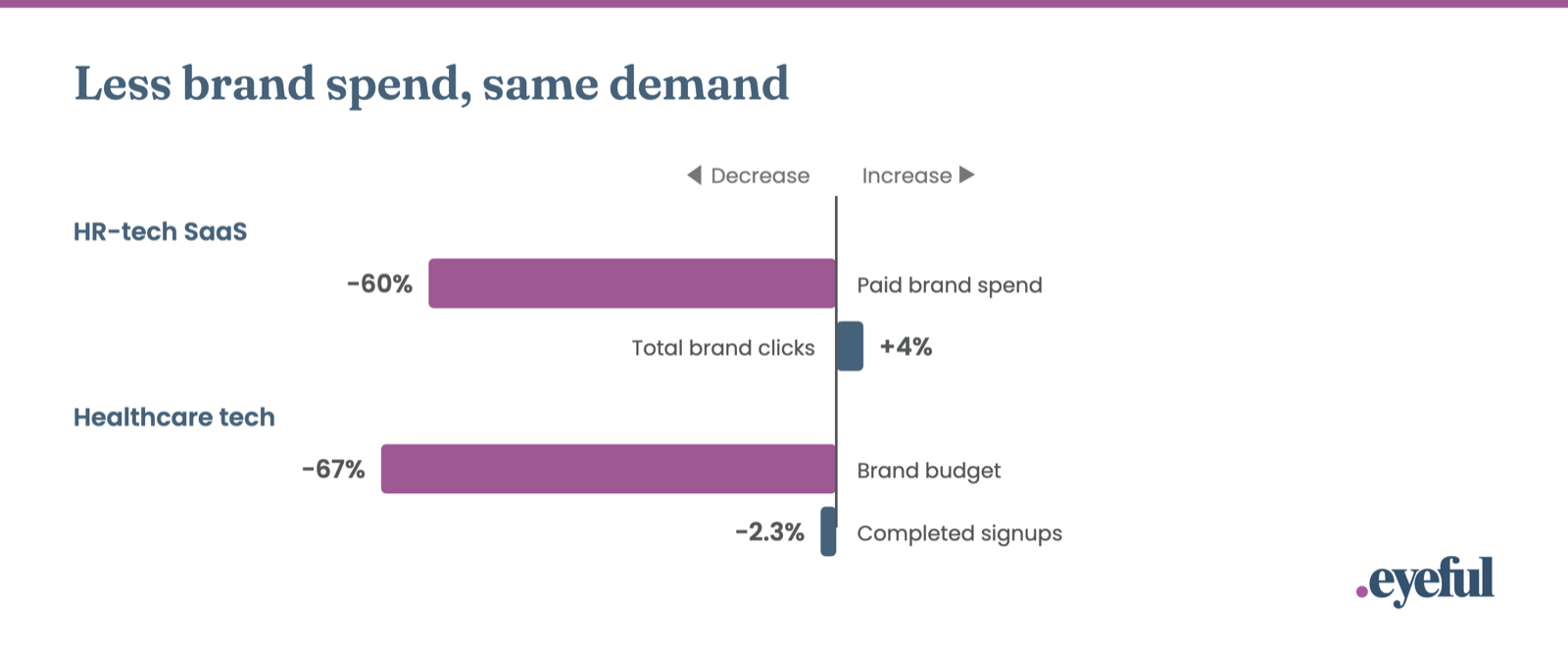
Fund tomorrow's demand with today's brand overspend. In two client tests, cutting brand spend 60–67% barely moved signups or clicks. Redirect that budget upstream, and judge it on leading indicators and incrementality, not last click.
Most B2B marketing agency performance programs start in the same place: paid search, a little paid social, and a dashboard built around MQLs, SQLs and pipeline. Someone has a need, searches for a solution, clicks on an ad and becomes a lead. It works, and it's easy to measure.
Capturing active buyers keeps the engine running, but it cannot create tomorrow's demand on its own.
When most of the budget goes to the channels with the cleanest attribution, marketing ends up focused on the small group of buyers who are already shopping. The much larger group of future buyers goes untouched until the day they start evaluating vendors. By then, it's usually too late to get on their list.
We think the stronger approach keeps demand capture as the foundation and builds awareness, consideration and preference long before a buying process starts.
Most of Your Future Customers Aren't Shopping Today
The LinkedIn B2B Institute's often-cited "95:5" rule says roughly 95% of potential buyers aren't in market at any given moment. The exact split varies by category and contract cycle, but the point holds: most of the people who will buy from you in the next two years aren't looking right now.
Some haven't recognized the problem you solve. Others have an incumbent that's good enough. They won't move until something changes: a new leader, a system that hits its limits, a budget cycle, a contract renewal.
When that buying process finally starts, they rarely begin with a blank slate.
Sources: Bain & Google B2B Buyer Journey Study, May 2022 (n=1,208); G2 Buying Behavior Report 2024.
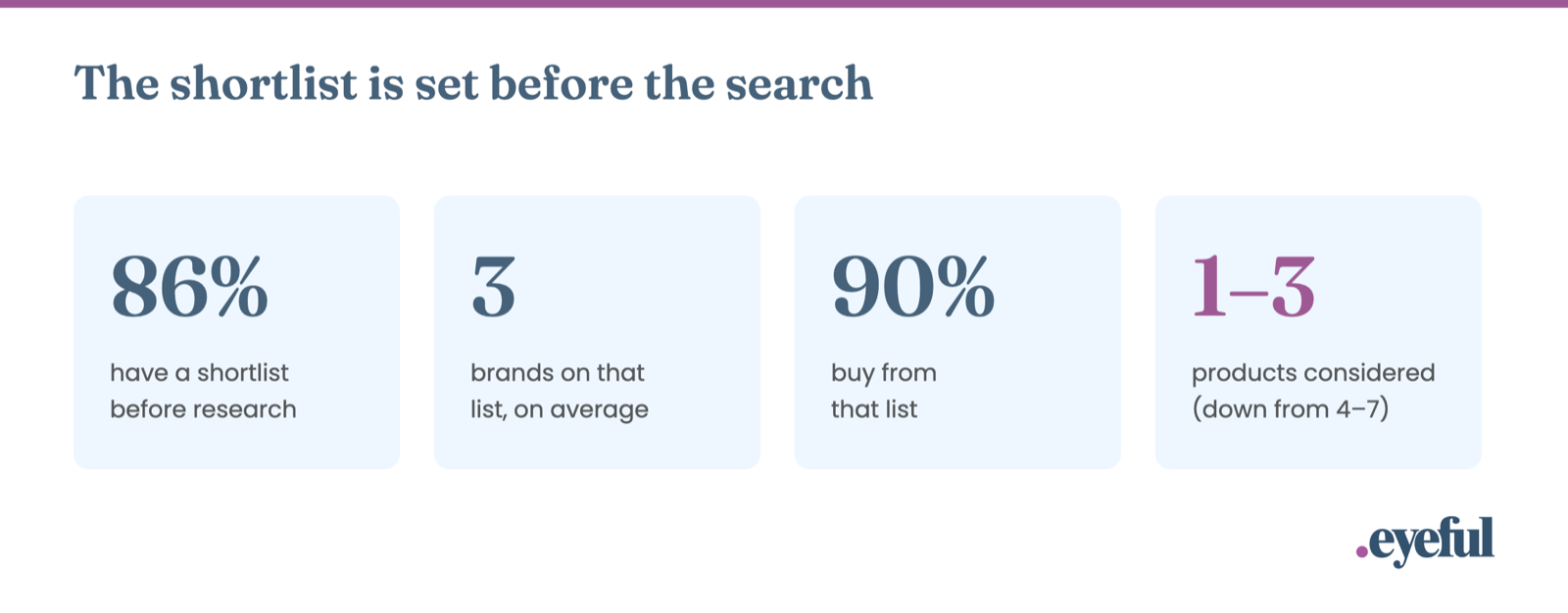
In Bain and Google's research, 86% of B2B buyers already had a list of brands in mind before they began their research, averaging 3 brands, and 90% ultimately bought from that day-one list. G2's 2024 buyer research found that the shortlist itself is shrinking: most buyers considered one to three products, down from four to seven the year before.
Buyers still research. Bain and Google found that 79% keep researching even with a day-one list, and 77% will add at least one vendor along the way. But the starting list does most of the work. If you aren't on it when the search starts, you're fighting for one of the few open spots.
That's the job of upper-funnel marketing: make your company familiar, relevant and credible before the moment of active demand.
The Buyer Isn't One Person, and the Path Isn't a Line
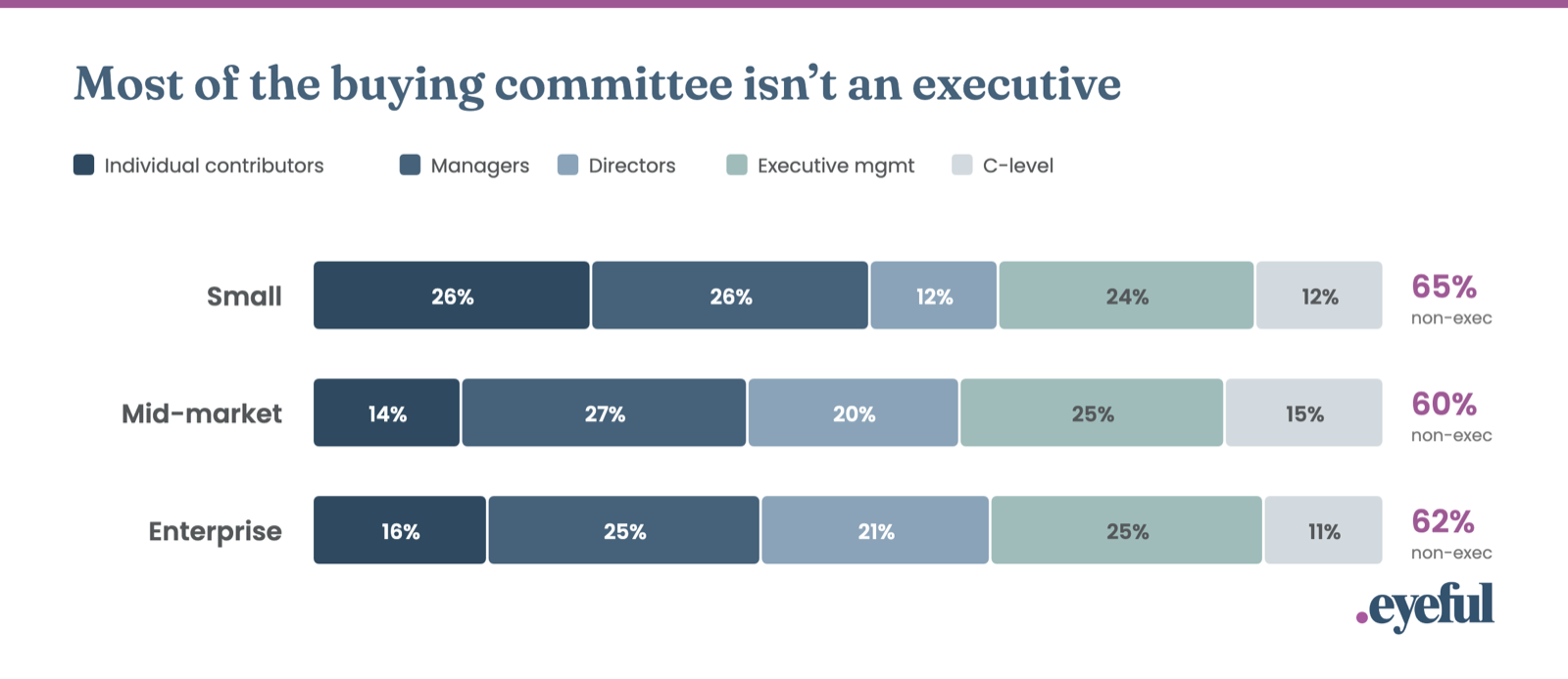
B2B decisions are made by committees, and most of the committee isn't in the C-suite.
Source: Google/Suzy B2B Buyer Journey Survey, US, July 2023.
Across small, mid-market and enterprise companies, about 6 in 10 decision stakeholders are individual contributors, managers or directors. Google and Bain's research on tech buyers found an average of 19 stakeholders, 48 touchpoints per buyer and eight key product considerations. One in five buyers spends four months or more in discovery alone.
Any of those people can start the conversation. A technical lead spots an integration problem. An operations manager hits a bottleneck. Finance questions the cost of the current system. Google's 2025 B2B research found that 42% of B2B stakeholders say evaluating providers is a constant, ongoing process, not something they do once a year.
The path isn't linear, either. McKinsey's recent work on travel booking describes the modern journey as a series of "orbits" that loop back through research and comparison, even after a purchase decision. B2B buying looks a lot like that. People move in and out of the market, revisit options, and pull in new stakeholders along the way.
So the better question is: How do we stay familiar to the whole committee, across a long, looping journey, so we're on the list when it forms?
Build Messaging for Each Stage of Awareness
Generating future demand requires more than running general brand awareness campaigns. Creative messaging needs to adapt as prospects move closer to a purchase decision.
Awareness: Who you are, what you do, and which problems you solve.
Problem recognition: Name the pain your buyers live with. Is this process costing you time? Is your current system limiting growth? Then connect it to a clear way forward.
Consideration and preference: Show how it works, what implementation looks like, and how similar companies solved the same problem.
Decision: Make it easy to take the next step: pricing, a demo, a trial, a consult.
One of the best sources of messaging is already inside your company: sales conversations. Instead of inventing campaign themes in a conference room, mine call recordings and transcripts for:
Objections
Desired outcomes
The stories your reps tell when a deal goes well
Pick the three to five themes that come up again and again. Those become the creative foundation for your upper- and mid-funnel programs, written in your buyers' own words.
One System, Three Jobs
The simplest way to plan a full-funnel program is to give each stage one job and one way to measure it.
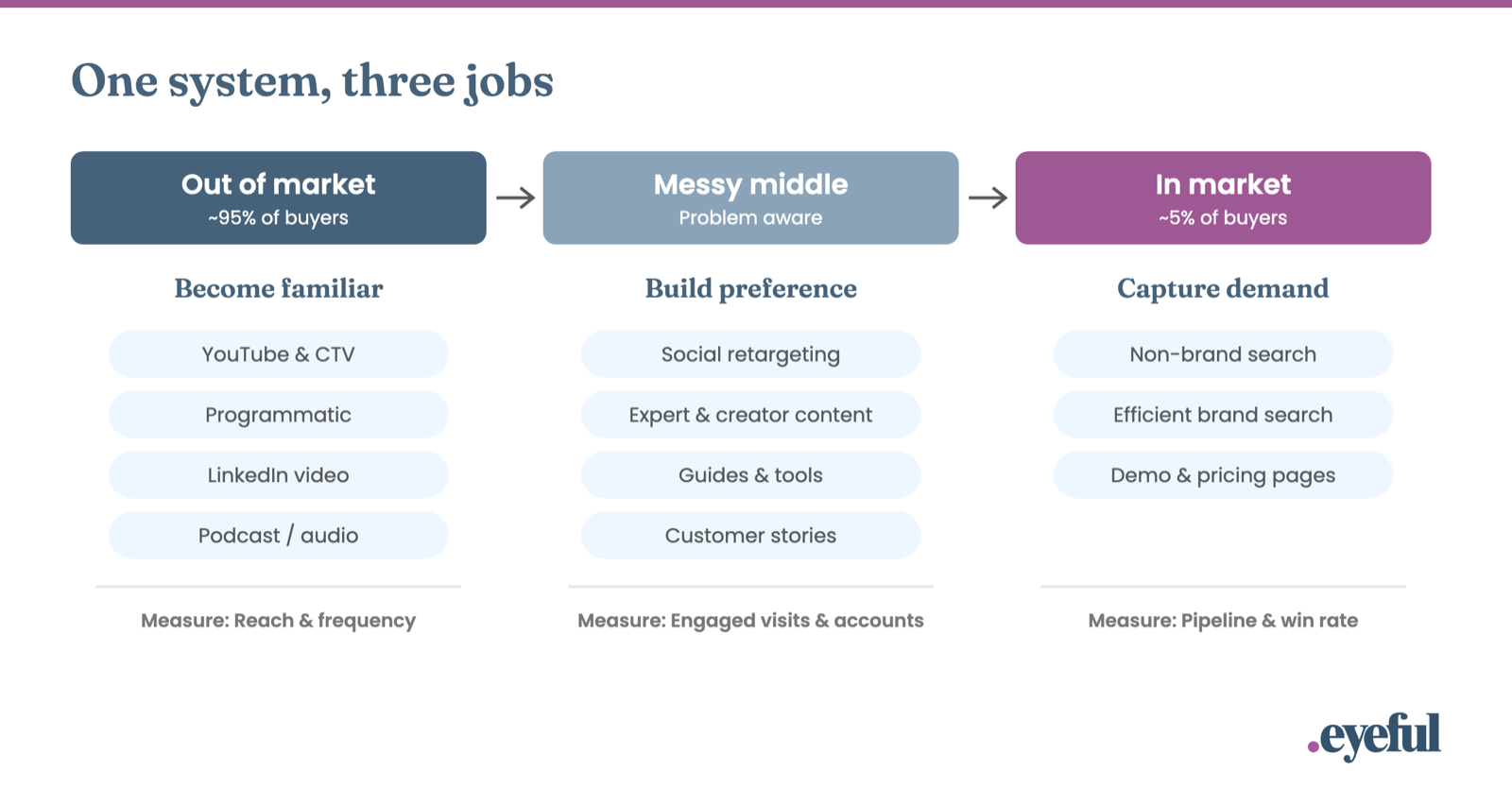
Eyeful's full-funnel planning model. Channels are typical, not prescriptive.
Out of Market: Become Familiar
Most B2B marketers already have an ideal customer profile (ICP). Some have named-account lists for account-based marketing (ABM). Others target industries and job functions across a broader market. Both can support upper-funnel reach.
Programmatic media is a flexible starting point because it spans display, online video, connected TV (CTV) and, where it fits, podcast and audio. Video deserves a hard look: Google's 2025 research found that 98% of B2B buyers had watched or listened to online video in the past week, and 55% of small businesses use YouTube for B2B product discovery.
If you have an enriched account list, you can often activate it through a programmatic platform, subject to the data provider's matching and privacy rules. If you don't, start with industry, company-size and job-function targeting. Use that reach to learn which audiences and themes earn real engagement, then narrow over time.
What we've seen: For a B2B software company whose program was almost entirely paid search and some paid social, we built a channel-expansion plan around a tight ICP: $250M+ in revenue, 500+ employees, multi-location manufacturers and retailers, and a buying committee of at least four.
Programmatic ABM was the core investment (about $10–25K a month), with smaller tests in YouTube, LinkedIn video and Google Demand Gen at $1–5K each. We told them plainly to expect the payoff to lag the spend by a quarter or more, and budgeted for an attribution partner from day one so we could connect accounts reached to accounts that became opportunities.
The Messy Middle: Build Preference
Once someone has seen you, social channels can deepen the relationship. LinkedIn and, where relevant, Meta can carry a sequence of short educational videos, customer proof points, product stories and invitations to explore deeper content.
This is also where expert-led content earns its place. An industry practitioner describing a familiar problem and how they solved it is often more persuasive than another brand claim. Paid and organic partnerships with credible subject-matter experts help buyers see themselves in the problem and trust the answer.
In Market: Capture Demand Efficiently
None of this is an argument against paid search. Non-brand search remains the most reliable way to capture buyers who are ready, especially in competitive categories. Make sure the pricing, demo and comparison pages they land on are doing their job.
But be careful how much you pay to capture demand that's already yours. Branded searchers often reach you through organic listings, and increasingly through AI-driven answers, whether you buy the click or not.
Source: Eyeful portfolio analyses (March 2026).
In two recent tests, cutting brand spend barely moved the outcome. A healthcare technology client cut its brand budget by 67% in a controlled geo test. Completed signups fell just 2.3% as organic search picked up the slack. An HR-tech SaaS client cut paid brand spend by about 60%, and total brand clicks actually rose 4%.
Brand search still plays an important role, but overspending on existing demand pulls budget away from building your future pipeline
What we've seen: When one SaaS company came to us, about 75% of its paid budget was going to brand, and paid pipeline had fallen sharply. We moved brand to impression-share bidding, redeployed the savings into non-brand search and the international markets where demand was outrunning budget, and tied every campaign to Salesforce pipeline stages. In the first 90 days, paid search generated about $500K in SQL pipeline on roughly $100K in spend. Paid MQLs rose from 21 in August to 29 in September, in a month when the company's overall MQL count fell.
Measure the System, Not Just the Last Click
A full-funnel strategy needs a full-funnel scorecard. Judge each stage on what it's built to do.
| Stage | What it should do | What to measure |
|---|---|---|
| Out of market | Build familiarity and relevance with the right accounts | Reach and frequency in your ICP or account list; brand and search lift; video completion |
| Messy middle | Turn familiarity into preference | Engaged visits, returning accounts, pricing and product page views, growth of qualified retargeting pools |
| In market | Convert ready buyers efficiently | MQL and SQL volume, conversion rates, cost per opportunity, pipeline velocity, win rate |
| The whole system | Grow profitable pipeline | Pipeline created, CAC vs. LTV, blended efficiency, shift of accounts from out of market to in market |
Two lessons from our own work:
Find the leading indicators that actually predict sales. At a healthcare software client, visitors who viewed pricing or clicked a demo CTA were 29× more likely to submit a sales form, and that signal drove more than 4× the volume of sales forms in paid search. Blog and learning content showed no lift on sales forms at all. Content should be judged by reach and engagement rather than form fills.
Don't let upper-funnel conversions train your bidding. At the same client, about 80% of the "form submission" events were eGuide downloads. One eGuide campaign was teaching Smart Bidding to buy PDF downloads, not pipeline. We paused it and optimized on sales-stage conversions instead.
None of these signals is proof of causation on its own. Some effects will never show up in a clean click path. Use a mix:
Multi-touch attribution for in-channel tuning
Marketing mix modeling for budget across channels
Incrementality tests (geo holdouts, lift studies) to check both
The real test is whether the whole system is producing more, and better, pipeline, not which ad got credit for a lead.
Invest Ahead of Demand
There's no universal budget split between awareness, consideration and demand capture. The right mix depends on how large and specific your audience is, media costs, competition, your organic visibility, sales cycle length, and the maturity of your demand-capture engine.
Start by working out what it costs to capture available demand efficiently. Then invest deliberately in the stages before it, and give that investment time. Upper-funnel spending pays back over quarters, not weeks.
Those upper stages are usually underfunded for one reason: their returns are slower and harder to attribute. That creates a loop. The channels that capture existing demand keep getting more budget, and the work that would create tomorrow's demand never gets enough budget to make a difference.
Continue investing in demand capture, while giving demand creation its own dedicated budget and timetable.
Building Pipeline for the Long Term
Sustainable B2B growth requires reaching accounts well before they type a solution into a search bar
It takes:
Reaching future buyers while they're still out of market
Helping the whole buying committee recognize the problem
Building trust with credible education
Earning a spot on the shortlist before the search begins
Keep the demand-capture foundation. Build awareness and consideration above it. Measure whether the whole system is getting more productive.
Capture today's demand. Invest now to be the brand buyers already know when tomorrow's demand shows up.
Is your marketing only catching buyers who are already looking? Our senior practitioners build full-funnel programs that connect awareness spend to real pipeline, and the measurement to prove it. No account managers, no junior handoffs. Let's talk.
Sources
Bain & Company and Google, B2B Buyer Journey Study, May 2022 (n=1,208 US B2B buyers)
Google and Bain & Company, B2B Discovery to Devotion study, US, 2022 (n=301 tech B2B buyers)
Google/Suzy, B2B Buyer Journey Survey, US, July 2023
Google, The B2B Boost, June 2025
G2, Buying Behavior Report, 2024
LinkedIn B2B Institute, the 95:5 rule
McKinsey & Company, research on the travel customer journey