
AI Discovery: What’s the Benefit of Showing Up in AI Overviews and Search Results?
By 2026, AI Search Engine Optimization has officially moved from something experimental and nice to have, to the core engine of digital survival. It’s hard to believe that just two years ago, SEO was still largely a game of matching keywords to a list of blue links. Today, the landscape has shifted entirely toward AI-generated answers in real time.
If your brand hasn’t adapted to this era of Generative Engine Optimization (GEO), you’re facing absolute invisibility as AI models become the primary gatekeepers of information. The stakes are easy to see: your brand is either the cited authority in an AI-generated answer, or it basically doesn’t exist in the buyer’s journey.
-
Market Dominance in AI Narratives: How being the primary source for an LLM establishes you as the industry leader.
Higher Trust from Users: Why an AI citation carries more weight than a paid advertisement.
Shortening the Sales Cycle: How AI overviews provide immediate answers that move customers to the "buy" phase faster.
Brand Omnipresence: Ensuring your brand is mentioned across ChatGPT, Perplexity, and Google Gemini.
The Shift from Traditional Search to AI-Driven Discovery
An interactive discovery loop has replaced the traditional search funnel. Instead of users browsing a list of links, AI models now act as personal researchers, synthesizing fragmented data into immediate, conversational answers that guide every stage of the modern buyer’s journey.
Modern audiences prefer instant, synthesized answers over hunting through a list of links. Your strategy has to change to respond. You need to create chunkable content that these models can easily grab and present.
To learn more about AI strategies, check out this blog: The SEO & AI Search Playbook to Help B2B Brands Win in 2026
Why AI Visibility is the New Standard for Organic Growth
If your brand isn’t showing up inside the actual AI response, being ranked #1 on a search page doesn’t really carry the weight it used to. This shift has made AI visibility the most critical KPI of the year. It’s a direct measure of how often an LLM suggests your business as the expert solution to a user’s problem.
Since these models now guide customers through every step (from that first how-to query to the final product comparison), securing a spot as a cited authority is the only way to stay relevant. To see how to position your brand for this, check out our blog: How eCommerce Brands Can Index for the AI Discovery Era.
Scaling Impact with AI-Driven Content Creation
Modern reach is built on reliability rather than volume. High-ranking brands focus on feeding the AI models that now guide how customers find and choose businesses. Smart AI-driven content creation focuses on feeding the models that now act as the primary gatekeepers for brand discovery.
Building Brand Authority in AI Search Results
When an AI model summarizes a topic and cites your brand, it gives you a unique stamp of approval. Most people are skeptical of traditional ads, but they tend to view AI as a neutral source. The AI pulls from the best info on the web, so its citation acts like a personal recommendation for your business.
This is where the idea of Share of Model becomes vital. In the past, brands focused on Share of Voice, which was mostly about how much noise they could make through ads. In 2026, the goal is to ensure your brand is the default answer the AI gives when someone researches your industry.
Showing up as a cited authority offers several advantages:
Lasting Mental Association: When a user sees your name cited repeatedly as the expert, they start to view you as the leader in that space.
Faster Sales: These users are often ready to buy by the time they reach your site. The AI has already done the heavy lifting by presenting you as the best solution.
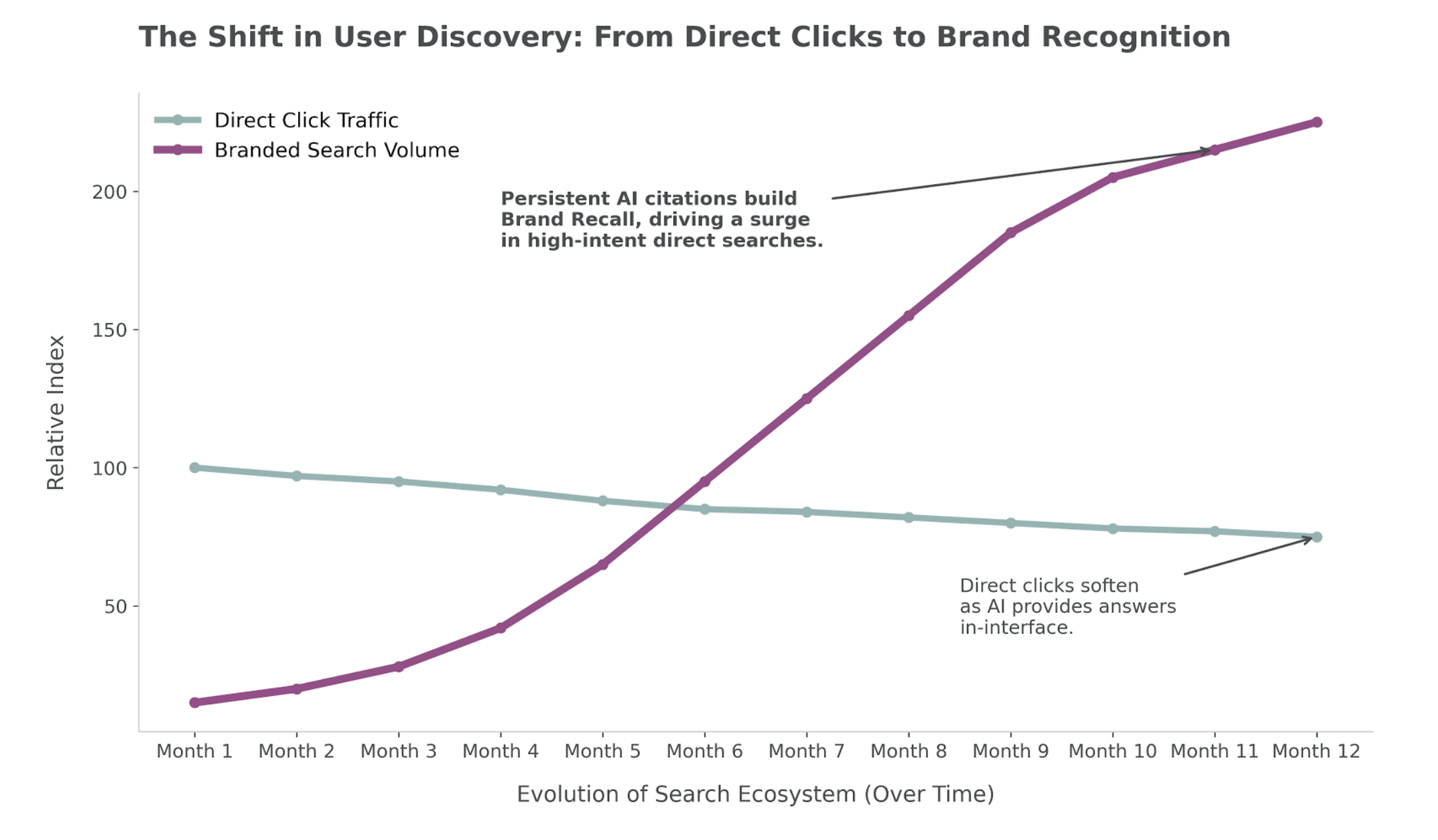
Direct Brand Demand: Once people recognize you as the expert, they stop asking the AI general questions and start searching for your company name directly.
These factors are proven ways to maximize revenue through SEO as search habits change. This approach keeps your brand profitable even as traditional website traffic shifts.
How AI Discovery Shortens the Sales Cycle
Ranking inside these AI results changes how customers interact with your brand before they ever visit your site:
Higher Intent: Visitors arriving from an AI citation usually have a clearer understanding of your value. They aren't just browsing; they are looking for the specific expertise the AI highlighted.
Fewer Questions: Much of the initial research happens within the AI interface. The user has already vetted your brand against others before they ever land on your site.
Faster Conversions: Because the AI has handled the awareness stage, the user can move straight to the buy phase. This reduces the time spent on lead nurturing.
Content Formats That Demand Clicks in 2026
Capturing traffic in a zero-click environment requires offering something an LLM cannot replicate. "High Information Gain" content, such as original data studies and proprietary industry insights, gives users a reason to leave the AI interface to find the full story.
Interactive assets, such as custom calculators or downloadable strategy templates, serve as essential resources that require a direct visit.
The most effective strategy treats the AI summary as a high-value teaser. The model provides enough of your perspective to build interest, while the proprietary depth remains on your site. This encourages users to click through for the full, expert-led experience.
Measuring Success with an AI Marketing Agency
Selecting a partner requires a shift from standard SEO checklists to a focus on how Large Language Models perceive your brand. A specialized AI Marketing Agency prioritizes new metrics that reflect visibility within generative responses rather than just counting clicks to a landing page.
Brand Mentions and Sentiment: Tracking how often AI models cite your business and the tone they use provides a clear picture of your digital reputation.
Branded Search Volume: Rising interest in your specific company name serves as the primary indicator that AI citations are successfully driving awareness.
Assisted Conversions: Traditional traffic data is making way for attribution models that credit AI platforms for starting the customer journey.
Your brand wins when you influence these signals enough to become the default recommendation.
Turning AI Visibility into a Competitive Advantage
Securing citations within AI responses builds a level of authority that traditional search rankings alone can't match. You can start shifting your strategy by focusing on these areas:
Audit structured data: Use clear Schema markup to help AI models parse and cite your information accurately.
Identify information gaps: Publish original data or proprietary research that offers value beyond what an LLM can summarize.
Track branded search volume: Monitor how often users search for your company by name to gauge AI-driven awareness.
Optimize for "chunkable" content: Use clear headings and place direct answers at the start of sections to simplify AI retrieval.
Maximize your brand's presence in the era of generative search with our Organic Search (SEO/GEO) Services.
FAQs
-
The golden rule of AI implementation is to keep humans in control. AI can improve speed and efficiency, but human oversight ensures accuracy, ethical use, and alignment with business goals. Successful teams treat AI as a tool, not a replacement for strategy.
-
The biggest challenges include data accuracy, maintaining an authentic brand voice, and managing privacy or bias concerns. Marketers must carefully review AI outputs, use reliable data sources, and establish clear guidelines so AI supports marketing goals without damaging trust.
-
Effective AI use follows four steps: prompt clearly, review the output, verify facts and accuracy, and repeat with improvements. This process helps teams refine results over time while ensuring AI-generated content remains reliable, useful, and aligned with brand standards.
-
Roles that rely on strategy, creativity, and human insight are the most future-proof. Positions like marketing strategists, brand leaders, data analysts, and creative directors require judgment and decision-making that AI tools support but cannot fully replace.
-
AI will increasingly power personalization, predictive analytics, and conversational discovery. As AI-driven platforms guide research and buying decisions, brands must focus on authority, structured data, and high-value insights to remain visible within AI-generated answers.